

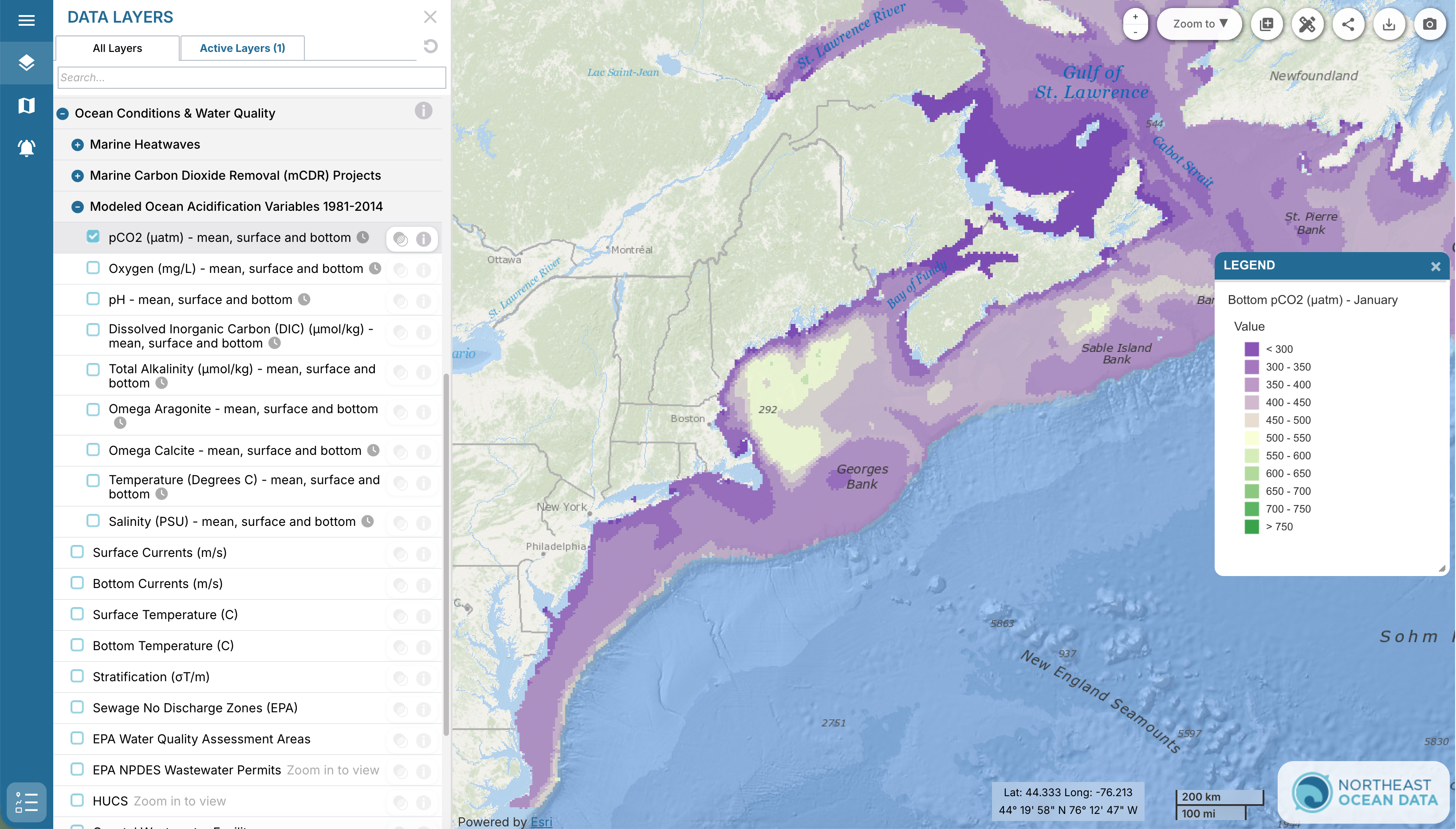
In late 2025, the Northeast Regional Ocean Council (NROC) collected feedback from ocean managers, Tribes, and industry for development of data and information on the Northeast Ocean Data Portal that can be used to inform decision making related to ocean acidification in the future. These groups noted the need for climatologies of ocean chemistry variables over time to characterize ocean acidification regionally and to use in simple overlays (e.g., with existing aquaculture sites) or more complex analyses.
The Portal recently added monthly mean climatologies for nine variables summarized for the surface and bottom ocean in the northwestern Atlantic from 1981-2014. The nine ocean acidification variables are:
-
- pCO2 (uatm)
- oxygen (mg/L)
- pH
- dissolved inorganic carbon (DIC)
- total alkalinity (umol/kg)
- omega aragonite
- omega calcite
- temperature (deg C)
- salinity (PSU)
The layers are derived from the application of a ROMS based regional model of the northwest Atlantic shelf as described in Siedlecki et al. 2025 (https://doi.org/10.31223/X5TM83). The model outputs have ~7 km horizontal resolution. The biogeochemical model relies on the Carbon, Ocean Biogeochemistry and Lower Trophics (COBALT) model in combination with regional empirical models to reconstruct the carbon variables. Using a 30-year historical simulation, Siedlecki et al. 2025 evaluated model results against in situ observations to estimate anthropogenic carbon inventories for the region. The full model spans 1981-2014 and is validated by observations from 2007-2014. To access the monthly data, add a variable to the Active Layers tab and use the time slider tool.
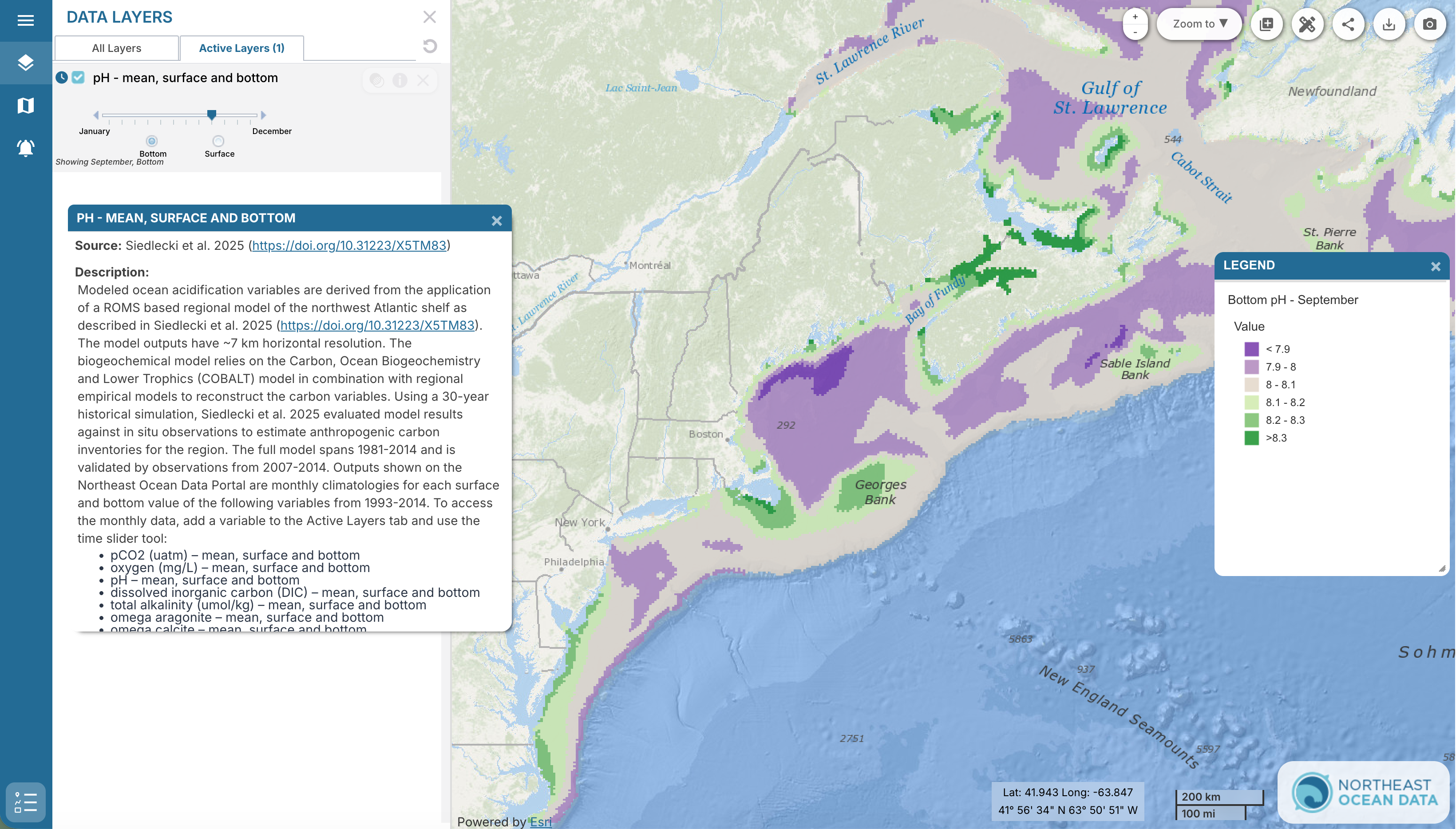
The maps of these variables reflect compound change; that is, multiple stressors changing in concert or closely, including warming, salinity changes, deoxygenation, and increasing anthropogenic carbon content. This compound change produces distinct regional changes and is driving unique trends over the northwest Atlantic shelf. Acidification hotspots in this time series include Wilkinson Basin and Hudson Canyon, likely driven by a combination of biological factors and broad-scale circulation changes (e.g., Labrador Current, Gulf Stream).
More information:
- Siedlecki, S.A., Soares, F., Chen, Z., Curchitser, E., Nguyen, H., Meseck, S.L., Alexander, M.A., Shin, S., Matassa, C.M., and Berger, H. 2025-07-26. Understanding historical and projected compound change on the Northwest Atlantic shelf. EarthArXiv. https://doi.org/10.31223/X5TM83.
- NROC Ocean Acidification Outreach Report (2025)
- Datasets used to validate the modeled ocean acidification variables:
- Coastal Ocean Data Analysis Product in North America (CODAP-NA); https://doi.org/10.5194/essd-13-2777-2021, 2021.
- Coastal Western Gulf of Maine Mooring: https://www.pmel.noaa.gov/co2/story/GOM
- Other Related Data:
- Global Ocean Carbon Data: https://www.ncei.noaa.gov/access/ocean-carbon-acidification-data-system/oceans/
- Changing Ecosystems and Fisheries Initiative Portal: https://psl.noaa.gov/cefi_portal/